When people think of a trip to Italy, their minds usually jump straight to Rome, Florence, Venice, or the Amalfi Coast — and rightly so, they’re extraordinary places. But Italy is made up of twenty regions, and some of the most authentic ones stay well off the mass-tourism radar. Here are three destinations that deserve far more attention than they get.
Puglia (Beyond Bari and Lecce)
Puglia is by now on many travelers’ maps, but its deeper corners remain largely unexplored. The Salento, the very tip of Italy’s “heel,” offers turquoise water comparable to the Caribbean, while the inland areas hide the trulli of Alberobello — the distinctive conical stone houses that are a UNESCO World Heritage site — and small whitewashed towns like Ostuni, the “white city.”
Absolutely worth trying: orecchiette con le cime di rapa, a dish made with ear-shaped pasta and turnip greens that’s a symbol of Puglian cuisine, and an evening stroll through one of the many masserie — ancient fortified farmhouses, often converted today into agriturismi (farm-stay inns).
Le Marche, the Region of a Hundred Hilltop Towns
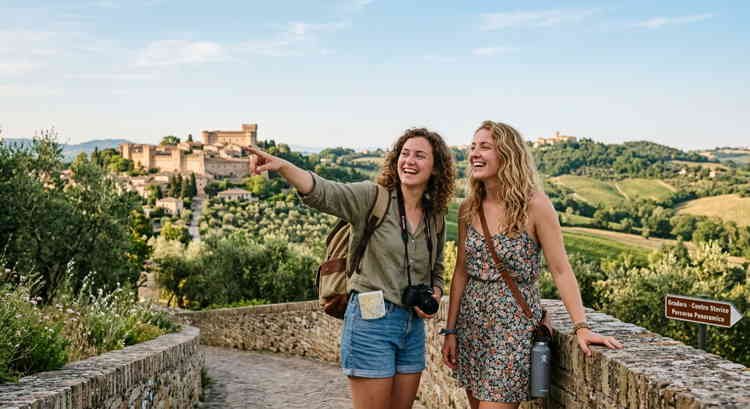
Nestled between Emilia-Romagna, Tuscany, and Umbria, but facing the Adriatic Sea, Le Marche remains one of Italy’s least-visited regions, despite offering mountains (the Sibillini Mountains), beaches, and an impressive number of well-preserved medieval hilltop towns — the region is said to have more than a hundred of them.
Urbino, birthplace of the painter Raphael, is a UNESCO World Heritage site and a small Renaissance gem often overshadowed by Florence. The regional cuisine deserves attention too: vincisgrassi, a lasagna enriched with chicken giblets, is a local specialty that you can try.
Molise, “the Region That Doesn’t Exist”
There’s even a running joke in Italy: “Molise doesn’t exist,” poking fun at the region’s small size and low profile. In reality, Molise is a small region with genuine charm, boasting green mountains, quiet hilltop towns like Agnone (famous for a bell foundry that’s been operating for centuries), and an unpretentious food tradition built around truffles and local cheeses.
Visitors to Molise find a rural, still “untamed” side of Italy, with especially warm hospitality — precisely because visitors are still relatively rare.

Basilicata, Home of the Sassi di Matera
Wedged between Puglia and Calabria, Basilicata is one of Italy’s least-populated and least-visited regions — which is precisely what makes it feel like stepping into an older, quieter Italy. Its main draw is Matera, whose sassi — ancient cave dwellings carved directly into the rock, inhabited since prehistoric times and later declared a UNESCO World Heritage site — create one of the most striking urban landscapes in the country, so much so that the city has doubled as ancient Jerusalem in several films.
Beyond Matera, Basilicata offers the wild beauty of the Pollino National Park, the small Tyrrhenian and Ionian coastlines that remain refreshingly uncrowded even in August, and a simple, hearty cuisine built around peperoni cruschi (crispy fried sweet peppers) and strong, aged pecorino cheeses. It’s a region that rewards travelers willing to rent a car and explore slowly, without a fixed itinerary.
Getting There Without a Car
If renting a car isn’t an option, all three regions are still reachable by train and regional bus, though connections are less frequent than on the classic tourist routes, so a bit of extra planning helps. Matera, for instance, is connected to Bari by a small private railway that’s an attraction in its own right, while regional buses link most of the hilltop towns in Le Marche and Molise to the nearest train stations — slower than driving, certainly, but part of the experience of visiting a region that hasn’t been fully reshaped around tourist convenience.
Booking accommodation a little further in advance than you would in more touristy areas is also wise, since options are fewer and word-of-mouth reputation still counts for a lot.
Why It’s Worth Straying From the Classic Routes
Visiting these regions isn’t just about avoiding crowds: it also means seeing a side of Italy closer to real daily life, talking with people used to a slower-paced tourism, and often practicing your Italian in a setting where English is, usually, far less common — a perfect opportunity for anyone learning the language.
If you found this article useful, don’t forget to share it with the world and to like our Facebook Page!
Credits:
Image by Gemini

 What to Expect From Your First Online Italian Lesson