Whether you are moving to Italy, raising bilingual children, or simply curious about how Italians grow up, understanding the school system is a great way to get a feel for the culture. It is quite different from the British, American, or Australian systems — and it comes with some wonderful quirks.
La Scuola dell’Infanzia — Nursery and Preschool (ages 3–6)
Italian children can start school at age three with la scuola dell’infanzia (nursery school / kindergarten). This stage is not compulsory, but most families choose it. The focus is on play, socialisation, and early language development.
Before this, there is l’asilo nido (nursery / day care) for children aged 0–3. The word nido literally means “nest” — which tells you everything about the Italian approach to early childhood. Che tenerezza! (How sweet!)
La Scuola Primaria — Primary School (ages 6–11)
Compulsory education begins at age six with la scuola primaria (primary school), which lasts five years. Children generally have the same class teacher — il maestro or la maestra — for most subjects, which creates a strong sense of continuity and relationship.
At the end of primary school, there is no national exam. Children simply move on to the next stage.
La Scuola Media — Middle School (ages 11–14)
Next comes la scuola media (middle school), which lasts three years. This is part of la scuola secondaria di primo grado (first-level secondary school). Students have different teachers for each subject, and the workload increases significantly.
At the end of la scuola media, students sit their first national exam: l’esame di terza media. Passing is required to move on to high school. It’s a significant step — ragazzi e ragazze (boys and girls) finally feel they’re crescendo (growing up)!

La Scuola Superiore — High School (ages 14–19)
This is where the Italian system really differs from many others. After la scuola media, students and families must choose a type of high school. There are three main options:
Il liceo — academic high school, focused on theoretical subjects. There are several types: liceo classico (Latin and Greek), liceo scientifico (science and maths), liceo linguistico (languages), liceo artistico (arts), and more.
L’istituto tecnico — technical institute, combining academic study with practical and vocational training.
L’istituto professionale — vocational school, focused on specific trades and professions.
High school lasts five years and ends with a major national exam: la Maturità (also called l’esame di Stato). This is a big deal in Italy — a rite of passage that every Italian remembers vividly. It involves written exams and an oral exam in front of a commission. The maximum score is 100, and achieving 100 e lode (100 with honours) is a great achievement. Ask any Italian and they’ll remember their esame di maturità with a mix of terror and nostalgia — è indimenticabile! (it’s unforgettable!)
L’Università — University
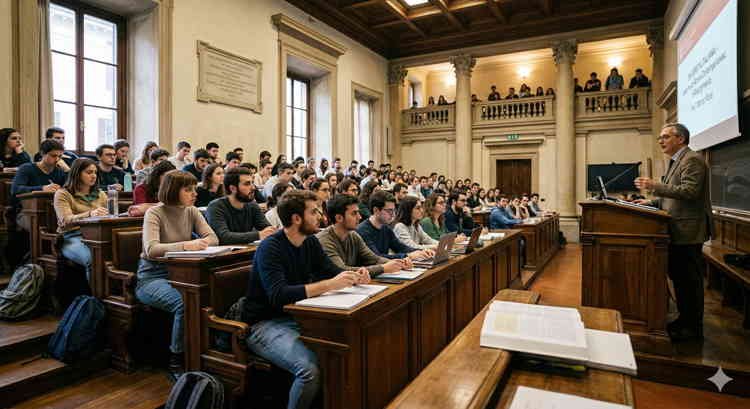
Italian universities — le università — follow the Bologna Process, meaning they are structured like most European universities: a three-year laurea triennale (Bachelor’s degree) followed by a two-year laurea magistrale (Master’s degree).
Italy has some of the oldest universities in the world. The University of Bologna, founded in 1088, is widely considered the world’s oldest university still in operation.
A Cultural Note: The Importance of Education in Italy
In Italy, education is deeply valued, and academic achievement is a source of great family pride. When someone graduates from university, it is traditional to celebrate with a party — la festa di laurea — where the graduate is often made to wear a corona di alloro (laurel wreath) and, in some regions, friends and family sing a famously irreverent traditional graduation song. It is all part of the fun.
If there is one thing that strikes almost every foreigner who encounters the Italian school system, it is how deeply personal it feels. The long relationship with a single maestro in primary school, the drama of the Maturità, the laurel wreath and the irreverent graduation song — these are not bureaucratic milestones. They are rituals that mark the passage of time and bind generations together.
Ask any Italian adult about their school years and you will get an instant reaction — pride, nostalgia, or the particular grimace of someone who remembers a difficult professor. School in Italy is not just education: it is a shared experience, a collective memory, a conversation starter that works across every social divide.
E tu, che ricordi hai della scuola che hai frequentato? (And you, what memories do you have of the school you attended?)
If you found this article useful, don’t forget to share it with the world and to like our Facebook Page!
Credits:
Image by Gemini



 How Long Does It Take to Become Fluent in Italian?