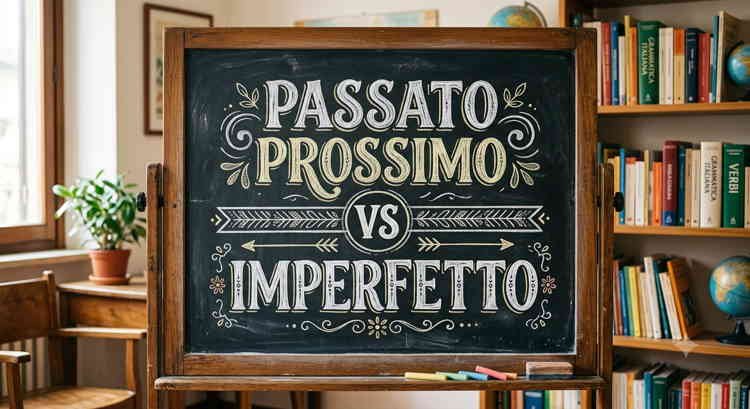
Let’s be honest: if there’s one topic that makes intermediate Italian learners want to close their textbook and go make a coffee instead, it’s this one. Passato prossimo or imperfetto? You know both tenses talk about the past, you know the endings, and yet somehow you still freeze every time you have to choose.
Don’t worry — you’re not alone, and the good news is that the logic behind this choice is much simpler than most grammar books make it look.
The Short Version
Here’s the rule I generally give all my students on day one: the passato prossimo tells you what happened (a specific, completed action), while the imperfetto tells you what things were like (a background, a habit, a description).
Think of it like a movie. The imperfetto is the scenery — the lighting, the weather, what people were doing in the background. The passato prossimo is the action that actually moves the plot forward.
Mentre guardavo la TV, è suonato il telefono.
(While I was watching TV, the phone rang.)
Notice how “guardavo” paints the scene, and “è suonato” is the single event that interrupts it.
Four Situations Where Imperfetto Wins
1. Descriptions in the past
La casa era grande e aveva un giardino. (The house was big and had a garden.)
2. Habitual or repeated actions
Da bambino, andavo sempre al mare in estate. (As a child, I always used to go to the seaside in summer.)
3. Ongoing actions interrupted by something else
Dormivo quando hai chiamato. (I was sleeping when you called.)
4. Age, time, weather, emotions in the past
Avevo dieci anni. Erano le tre. Faceva freddo. Ero felice.
Four Situations Where Passato Prossimo Wins
1. A completed, specific action
Ho mangiato una pizza ieri sera. (I ate a pizza last night.)
2. An action with a clear beginning and end
Ho vissuto a Roma per tre anni. (I lived in Rome for three years — and now I don’t anymore.)
3. A sequence of events
Mi sono svegliato, ho fatto colazione e sono uscito.
4. Something that happened once
Ho visto quel film una volta sola.
The Trap: Same Verb, Different Meaning
This is where it gets interesting, and where most textbooks fail to explain why. Some verbs genuinely change meaning depending on the tense you choose:
- Conoscevo Marco (I knew Marco — I was already acquainted with him)
- Ho conosciuto Marco (I met Marco — for the first time)
- Sapevo la verità (I knew the truth — an ongoing state of knowledge)
- Ho saputo la verità (I found out the truth — the moment I learned it)
This isn’t a grammar technicality to memorize; it actually reflects the core logic of the two tenses. One is a state, the other is an event.
A Trick That Actually Works
When you’re not sure which tense to use, ask yourself: “Am I describing, or am I narrating?”
If you’re setting the scene — describing how things were, felt, or looked — reach for the imperfetto. If you’re telling someone what happened next, what actually occurred, use the passato prossimo.
Try it with this sentence: “It was raining, so I stayed home.”
- Pioveva (description of the weather) → imperfetto
- sono rimasto a casa (the actual decision/action) → passato prossimo
Pioveva, quindi sono rimasto a casa.
Practice Makes the Difference
Reading grammar rules will only get you so far — this is a tense pair you really absorb by listening and speaking. Try narrating your day out loud in Italian, and notice which parts feel like “background” and which parts feel like “events.” That instinct is exactly what native speakers rely on; they’re not running through rules in their head, they simply feel the difference.
If you’d like to practice this live, with real-time correction and examples built around your own experiences, this is exactly the kind of thing we work on together in one-on-one lessons — it’s one of those topics that clicks so much faster with a conversation partner than with a textbook alone.
If you found this article interesting, don’t forget to share it with the world and to like our Facebook Page!
Credits:
Image by Gemini



 Can You Learn Italian Without Living in Italy? Here’s What Actually Works