Here’s something that surprises a lot of my students: the “standard Italian” you’re learning in your textbook is, historically speaking, a fairly recent invention. For most of Italian history, there wasn’t one Italian language — there were dozens.
If you’ve ever traveled through Italy and struggled to understand a local conversation even after years of study, this article will explain why, and why it’s absolutely not a sign that you’re doing something wrong.
Where “Standard Italian” Actually Came From
Modern standard Italian is based on the Florentine dialect of Tuscany, largely thanks to the enormous influence of Dante, Petrarch, and Boccaccio, whose 14th-century writings became the literary foundation of the language. But for centuries, this “literary Italian” was mostly spoken by educated elites, while the vast majority of the population spoke their own regional language at home.
Italy wasn’t unified as a single country until 1861, and even then, it’s estimated that only a small percentage of the population could actually speak what we’d now call standard Italian fluently. Regional dialects remained the everyday language for most people well into the 20th century — television, more than schooling, is often credited as the real force that spread a shared national Italian. For example, the TV program Non è mai troppo tardi was a pioneering educational show designed to combat adult illiteracy in Italy. Broadcast by Rai in the 1960s and hosted by teacher Alberto Manzi, it helped nearly a million adults earn their primary school diplomas through engaging drawings and accessible lessons. Beyond basic literacy, the program played a crucial role in unifying the country by teaching a standardized national Italian to a population previously divided by strong regional dialects.
Dialect, or a Different Language?
This is where it gets genuinely interesting: many so-called “Italian dialects” aren’t simply accented versions of standard Italian — linguistically, many of them are separate Romance languages in their own right, with their own grammar, vocabulary, and history, distinct from Italian rather than derived from it.
- Napoletano (Neapolitan) — spoken in and around Naples, recognized by UNESCO as a distinct language
- Siciliano (Sicilian) — with influences from Greek, Arabic, and Spanish due to the island’s history
- Veneto — spoken in the Venice region, quite different from standard Italian in both sound and vocabulary
- Sardo (Sardinian) — considered by many linguists to be the Romance language furthest from standard Italian
- Piemontese, Lombardo, Romagnolo, Pugliese, Calabrese — and dozens more, each tied to a specific region
Why This Matters for Learners
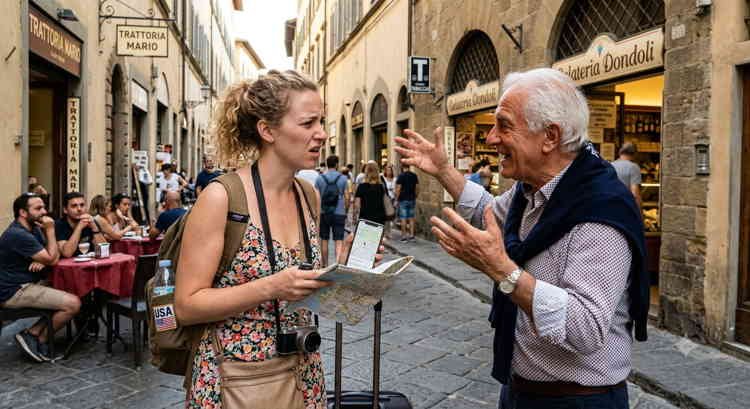
If you’ve studied Italian for a while and then visited, say, Naples or a small village in Calabria, and found yourself lost even in a simple conversation between locals, that’s completely normal — you weren’t hearing “fast Italian,” you were likely hearing genuine dialect, which can be nearly incomprehensible to someone who only knows standard Italian (and sometimes even to other Italians from different regions!).
The good news: standard Italian is what’s taught in schools, used in national media, and spoken (or at least understood) by virtually everyone in Italy today, even in regions where dialect is still used at home. You don’t need to worry about learning a dialect to communicate — but understanding that dialects exist, and are a source of real pride for many Italians, will help you make sense of a lot of what you encounter.
How to Approach This as a Learner
You don’t need to study dialects to become fluent in Italian — focus on standard Italian, which will let you communicate anywhere in the country. But do pay attention: if a native speaker uses a word you can’t find in any dictionary, there’s a good chance it’s regional, and that’s genuinely worth asking about. Italians tend to love explaining their regional quirks — it’s a great way to build real cultural connection, not just vocabulary.
If you’re curious about the regional flavor of Italian — whether it’s an expression you heard on a trip, in a movie, or from a friend — that’s exactly the kind of question I love digging into during lessons, because it often reveals something about Italian culture that no textbook covers.
If you found this article interesting, don’t forget to share it with the world and to like our Facebook Page!
Credits:
Image by Gemini



 Italian Double Negatives: Why “Non Vedo Nessuno” is correct