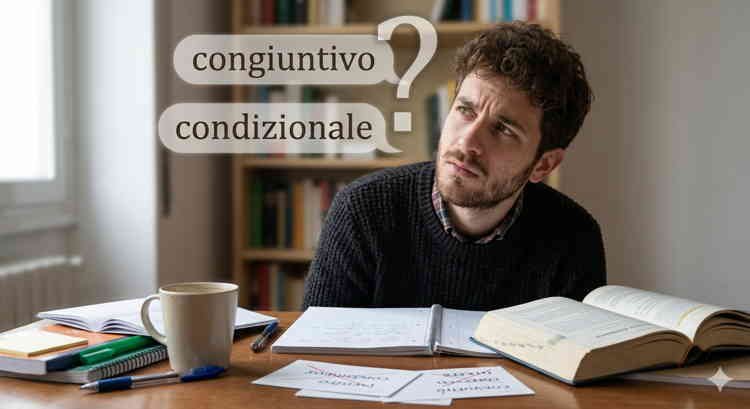
Ask any Italian learner what their biggest grammar headache is, and chances are they will say: the congiuntivo (subjunctive). But here’s something that often gets overlooked — the condizionale (conditional) is just as tricky, and the two are frequently confused. Che confusione! (What a confusion!) But don’t worry — we’ll sort it out together.
Let’s fix that today with a clear, practical guide.
What is the Congiuntivo?
The congiuntivo is used to express doubt, uncertainty, wishes, emotions, and opinions. It almost always appears in the second part of a sentence (a subordinate clause), introduced by che (that).
Think of it as the “maybe mood” — it signals that something is subjective, uncertain, or desired rather than stated as a plain fact. It reflects the speaker’s stato d’animo (their state of mind), their mood and inner attitude.
Common triggers for the congiuntivo:
pensare che — to think that: Penso che Marco abbia ragione (I think Marco is right)
sperare che — to hope that: Spero che tu stia bene (I hope you are well)
volere che — to want (someone) to: Voglio che tu venga (I want you to come)
sebbene / benché — although: Sebbene sia stanco, continuo a lavorare (Although I’m tired, I keep working)
prima che — before: Telefonale prima che parta (Call her before she leaves)
What is the Condizionale?
The condizionale is used to talk about hypothetical situations, polite requests, and things that would happen under certain conditions. Think of it as the “would mood”.
You use it in sentences with se (if), or when being polite:
Vorrei un caffé, per favore. (I would like a coffee, please.) — much more polite than Voglio un caffé!
Se potessi, viaggerei ogni giorno. (If I could, I would travel every day.)
Cosa faresti al mio posto? (What would you do in my position?)
Dovresti studiare di piu. (You should study more.)

The Classic Confusion: se + congiuntivo or condizionale?
This is where many students get stuck. In hypothetical se (if) sentences, the rule in Italian is:
se + congiuntivo imperfetto → condizionale presente (for unlikely or hypothetical situations):
Se avessi piu tempo, imparerei il cinese. (If I had more time, I would learn Chinese.)
se + congiuntivo trapassato → condizionale passato (for things that didn’t happen in the past):
Se avessi studiato, avrei superato l’esame. (If I had studied, I would have passed the exam.)
Important: in Italian you never say se + condizionale. This is a very common mistake even among some native speakers in informal speech, but in correct Italian, the se clause always takes the congiuntivo. Ricordatelo bene! (Remember it well!)
A Simple Trick to Tell Them Apart
Ask yourself: am I describing how things would be (use condizionale) or expressing a doubt, wish, or opinion (use congiuntivo)?
Credo che venga alla festa (I think he’s coming at the party) — doubt/opinion → congiuntivo
Verrebbe se potesse (He would come if he could) — hypothetical → condizionale
With practice, it becomes instinctive. And remember: even some Italians sometimes mix them up in everyday speech. So don’t be too hard on yourself — non ti preoccupare troppo! (don’t worry too much!)
If you found this article useful, don’t forget to share it with the world and to like our Facebook Page!
Credits:
Image by Gemini



 Can You Really Learn Italian Without a Teacher?