Italy is famous for its great celebrations: Venice Carnival, Siena’s Palio, the Infiorata of Noto. But travel a little off the beaten track and you will discover a whole other world of local festivals — sagre, rievocazioni storiche, and downright bizarre traditions — that have been celebrated for centuries and are fiercely protected by the communities that host them.
La Sagra: Italy’s Local Food Festival
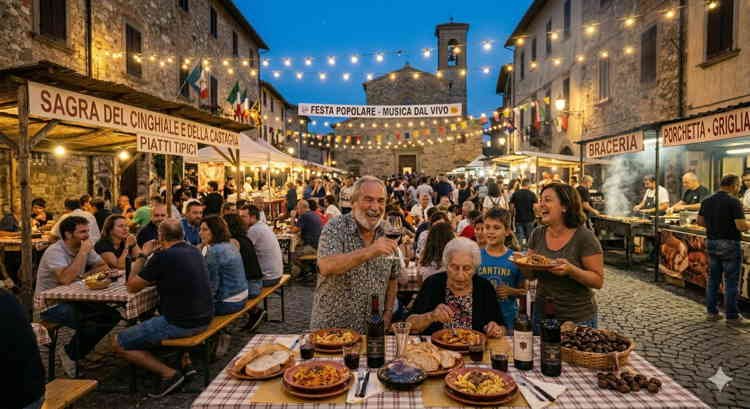
The word sagra comes from the Latin sacra (sacred things), and originally referred to a village patron saint’s feast day. Today, una sagra is essentially a local food festival dedicated to a single product: the sagra del tartufo (truffle festival), the sagra della polenta (polenta festival), the sagra del cinghiale (wild boar festival).
Every Italian region, every small town, has its sagra. Some are elegant affairs with long banquet tables set in medieval squares. Others are wonderfully chaotic events where entire families queue for hours for a plate of pasta e fagioli (pasta and beans). Either way, they are unmissable.
La Giostra della Quintana — Foligno, Umbria
Held twice a year in the beautiful Umbrian town of Foligno, the Giostra della Quintana is one of Italy’s most spectacular medieval jousting tournaments. Twelve horsemen, representing the twelve districts of the town, compete on horseback to hook a series of rings of decreasing size with their lances.
The event is accompanied by a massive medieval procession of over 800 people in period costume — all meticulously researched and handmade. The rivalry between the districts (called rioni) is intense and completely genuine. This is not a show for tourists — it is a living part of local identity.

Il Palio dei Ciuchi — Torrita di Siena, Tuscany
You may have heard of Siena’s famous Palio horse race. Far less known — but equally charming — is the Palio dei Ciuchi (the Donkey Race), held in the nearby village of Torrita di Siena every spring. Eight donkeys, each representing a district of the town, race around the main square while their riders do their best to stay on.
The event began as a satirical parody of the grand Palio and has since become a beloved tradition in its own right. The donkeys, in particular, have strong opinions about participating. As the Italians say, even the ciuchini (little donkeys) have their own character!
La Festa dei Ceri — Gubbio, Umbria
Every year on the 15th of May, the citizens of Gubbio carry three enormous wooden structures called ceri (candles) up the steep slopes of Monte Ingino to the Basilica of Sant’Ubaldo. Each cero, weighing around 400 kg and standing four metres tall, is dedicated to a patron saint and carried on the shoulders of teams of men called ceraioli.
The race — for it is a race of sorts — has been held since at least the 12th century and has been recognised by UNESCO as part of the Intangible Cultural Heritage of Humanity. The energy of the crowd and the sheer physical effort of the ceraioli make this one of the most extraordinary spectacles in Italy.
How to Find Your Sagra
Almost every Italian town holds at least one sagra per year, usually in summer or early autumn. The best way to find them is to ask locally — look for hand-painted signs, posters on lampposts, or simply ask in the nearest bar. Websites such as sagre.info list hundreds of events across Italy.
If you are planning a trip to Italy, building a sagra or local festival into your itinerary is one of the best decisions you can make. You will eat well, you will laugh, and you will see an Italy that no guidebook can quite capture. Come dicono gli italiani: paese che vai, usanza che trovi! (Every place has its own customs!)
If you found this article interesting, don’t forget to share it with the world and to like our Facebook Page!
Credits:
Image by Gemini

 Italian Colour Expressions: What Does It Mean to ‘See Everything Pink’?