Every culture has its superstitions, but Italy takes them to a whole new level. Whether you are a sceptic or a true believer, understanding Italian superstitions is a wonderful window into the country’s soul — and it will definitely help you avoid a few awkward moments if you ever spend time with an Italian family. Pronto? Iniziamo! (Ready? Let’s begin!)
Il Malocchio — The Evil Eye
Perhaps the most famous Italian superstition is il malocchio (the evil eye). The idea is simple: someone can cast a curse on you just by looking at you with envy or malice. The effects? Bad luck, headaches, general misfortune.
To protect themselves, many Italians wear il cornetto (a small red horn-shaped charm). You will see il cornetto hanging in cars, shops, and homes all over Italy, especially in the south.
If you think someone has given you il malocchio, the traditional remedy involves a nonna (grandmother) who knows the secret ritual — usually involving olive oil dropped into water and a whispered prayer. Each region has its own version!
Il Numero 17 — Italy’s Unlucky Number
While most of the Western world fears the number 13, in Italy the truly unlucky number is 17. Why? Well, it’s unclear but one theory is because in Roman numerals, 17 is written as XVII — which can be rearranged to spell VIXI, a Latin word meaning “I have lived” (i.e., I am now dead). Not exactly a cheerful association. Adesso capisci perché gli italiani lo evitano? (Now do you understand why Italians avoid it?)
As a result, many Italian buildings skip the 17th floor, and if your flight leaves on the 17th of the month, a superstitious Italian might think twice about booking. Che sfortuna! (What bad luck!)

Venerdì 17 — The Italian Friday the 13th
Combining the unlucky number 17 with venerdi (Friday) gives you the Italian equivalent of Friday the 13th: Venerdì 17. This is considered the unluckiest day of the year. There is even an Italian saying: “Di venere e di marte non si sposa e non si parte” — which roughly means, “On Fridays and Tuesdays, don’t marry and don’t travel.”
Gatti Neri e Specchi Rotti — Black Cats and Broken Mirrors
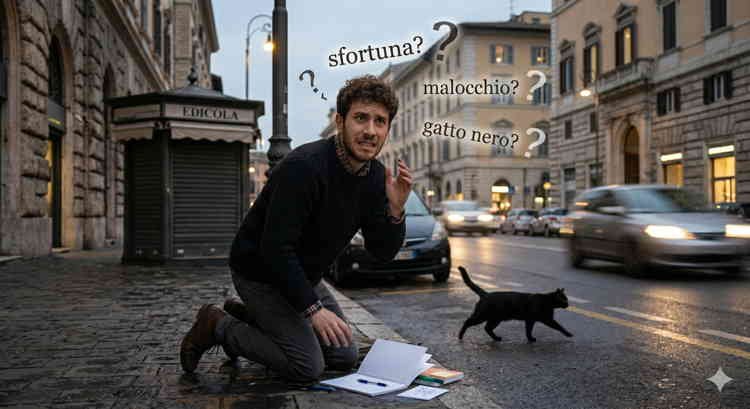
Like in many other countries, un gatto nero (a black cat) crossing your path is considered bad luck. Italians will often stop, wait, or take a different route if this happens. Meglio non rischiare! (Better not risk it!)
Breaking a mirror — rompere uno specchio — is said to bring seven years of bad luck, just as in many other cultures. And aprire un ombrello in casa (opening an umbrella indoors) is another classic porta sfortuna (brings bad luck) moment.
Lucky Charms and Good Omens
Of course, not everything is about bad luck. Italians also have a rich tradition of portafortuna (good luck charms). Besides il cornetto, finding a four-leaf clover — un quadrifoglio — is a great omen, and il ferro di cavallo (a horseshoe) hung above a door brings luck to the home.
Whether you believe in any of this or not, one thing is certain: Italian superstitions are part of the cultural fabric of the country. As the Italians say, “non è vero, ma ci credo” — it’s not true, but I believe it anyway. Tocca ferro! (Touch iron — the Italian equivalent of “touch wood”!)
If you found this article interesting, don’t forget to share it with the world and to like our Facebook Page!
Credits:
Image by Gemini


 Italian Subjunctive vs Conditional: Which One Do You Actually Use?