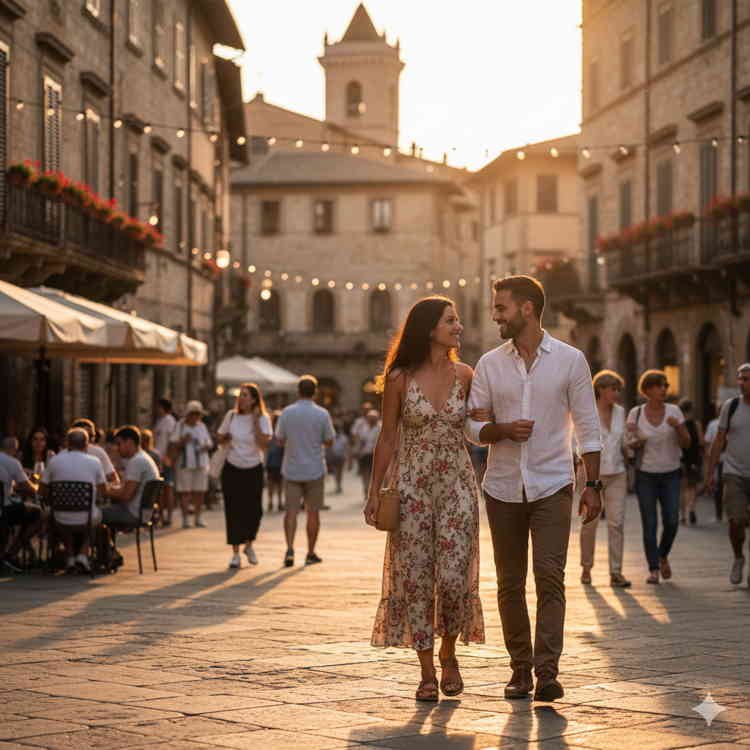
If you’ve ever visited Italy during the early evening hours, you’ve likely witnessed a peculiar phenomenon: seemingly the entire town spilling onto the streets, dressed in their finest casual attire, strolling back and forth with no apparent destination. This isn’t a special event or festival—it’s the passeggiata, one of Italy’s most cherished daily rituals and perhaps the country’s most beloved unofficial sport.
What Exactly Is the Passeggiata?
The passeggiata (pronounced pah-seh-JAH-tah), literally meaning “a walk” or “a stroll,” is the Italian tradition of taking a leisurely evening walk through the town center or main street. Unlike a workout or a commute, the passeggiata serves no practical purpose beyond socializing and being seen. It typically occurs between 5 PM and 8 PM, when Italians of all ages emerge from their homes to partake in this communal ritual.
The beauty of the passeggiata lies in its simplicity. There’s no fitness app tracking your steps, no podcast competing for your attention, and no urgency to arrive anywhere. Instead, it’s about connecting with neighbors, greeting friends, showing off new clothes, and quite simply, enjoying the act of being together in public space.
The Unwritten Rules of the Ritual
While the passeggiata may appear casual to outsiders, there are certain cultural codes that participants instinctively follow. First and foremost, appearance matters. Italians don’t simply throw on sweatpants for their evening stroll—the passeggiata demands a certain level of presentation. Clean clothes, styled hair, and perhaps a touch of perfume or cologne are standard. After all, you’re likely to run into people you know.
The route is equally important. Most towns have a designated passeggiata circuit, often centered around the main piazza or the corso (main street). Participants walk the same loop repeatedly, creating a predictable flow where encounters with friends and acquaintances are inevitable. You might hear exchanges like “Ciao, come stai?” (“Hi, how are you?”) echoing across the street dozens of times during a single evening.
Speed is another crucial element. The passeggiata is emphatically not a power walk. The pace is deliberately slow, almost languid, allowing for spontaneous conversations, window shopping, and people-watching. Stopping mid-stroll to chat with a neighbor for fifteen minutes is not just acceptable—it’s expected.

A Social Fabric That Holds Communities Together
The passeggiata serves functions that extend far beyond simple exercise. In Italian towns and cities, it acts as social glue, maintaining the connections that hold communities together. Elderly residents can stay engaged with neighborhood life without requiring special arrangements. Young people can flirt and socialize under the watchful eyes of their community. Parents can supervise children while chatting with other adults. Business owners can gauge the mood of their town and exchange greetings with customers.
This daily ritual creates what sociologists call “weak ties”—the acquaintances and familiar faces that make a place feel like home. When you regularly see the same people during the passeggiata, you develop a sense of belonging and mutual recognition that’s increasingly rare in modern life. You might not know everyone’s life story, but you know their face, their typical walking route, and perhaps that they always wear that distinctive blue scarf.
Regional Variations and Modern Adaptations
While the passeggiata is practiced throughout Italy, it takes on different characteristics depending on the region. Modern life has challenged this ancient tradition. Increased car traffic, shopping mall culture, and digital entertainment have all competed for the attention once devoted to evening strolls. Yet remarkably, the passeggiata persists, especially in smaller towns and historic city centers where pedestrian areas make the ritual practical and pleasant.
Some Italian cities have actively supported the tradition by creating more pedestrian zones and closing certain streets to traffic during peak passeggiata hours. This urban planning decision acknowledges that the ritual isn’t merely nostalgic but serves vital social and cultural functions worth preserving.
Why Italy Got It Right
In an age of increasing isolation and screen-based interaction, the passeggiata offers something profoundly valuable: structured social time built into daily life. It doesn’t require gym memberships, special equipment, or even planning. It’s democratic—everyone is welcome, regardless of age, fitness level, or economic status.
The tradition also promotes better health outcomes, though that’s hardly the point. The gentle exercise, social connection, and stress reduction that come from regular passeggiate contribute to the Mediterranean lifestyle that health researchers consistently praise.
Perhaps most importantly, the passeggiata reminds us that community doesn’t happen automatically—it requires regular investment of time and presence. By designating this daily hour for collective life, Italians have created a renewable resource of social capital that enriches individual lives while strengthening the broader community.
The next time you visit Italy, skip the evening Netflix session and join the passeggiata. You might discover why Italians consider walking around to be their favorite sport.
If you found this article useful, don’t forget to share it with the world and to like our Facebook Page!
Credits:
Image by Gemini



 Hidden Italian Towns Worth Skipping Rome For (Yes, Really)