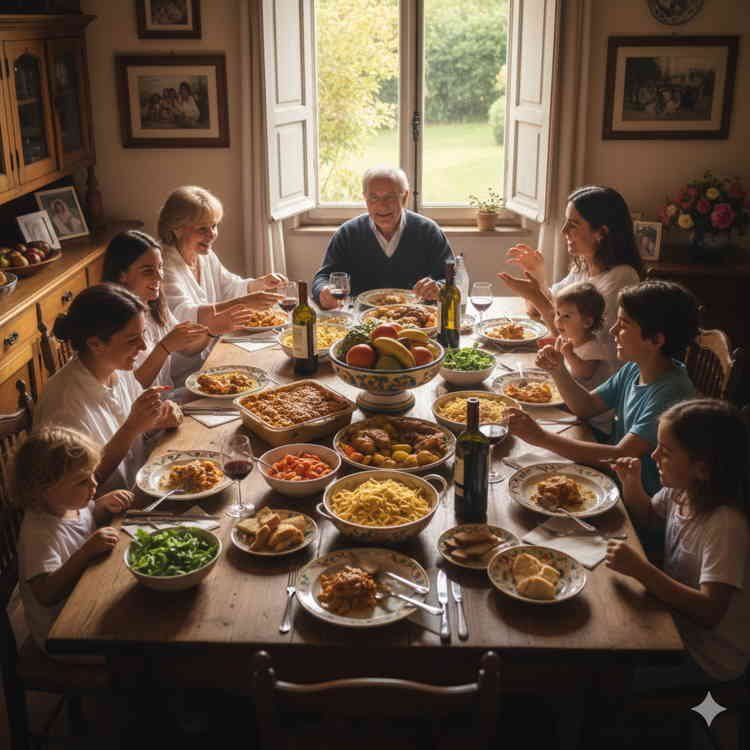
There’s a moment of deceptive calm when you first arrive at an Italian family’s Sunday lunch. The doorbell rings, you’re welcomed with warm kisses on both cheeks, and you think to yourself: “This seems nice and manageable.” Then you step into the kitchen, and suddenly you’re swept into a whirlwind of animated conversations, clinking plates, and the intoxicating aroma of simmering ragù that’s been cooking since dawn. Welcome to the beautiful chaos of Italian family life.
The Sacred Ritual of Sunday Lunch
In Italy, Sunday lunch isn’t just a meal—it’s a cultural institution that has survived modernization, fast food chains, and even the digital age. While many Western countries have abandoned the tradition of weekly family gatherings, Italian families continue to congregate religiously every Sunday for lunch. This isn’t a casual brunch where people drift in and out. This is a multi-hour commitment that typically involves at least three generations, countless courses, and enough food to feed a small village.
For first-timers, whether you’re a foreign partner meeting your significant other’s family or an exchange student invited by a local friend, the experience can be overwhelming. But understanding the unspoken rules and cultural nuances can transform potential awkwardness into an unforgettable experience.
Timing Is Everything (But Not Really)
Italians have a complicated relationship with punctuality. While arriving late to a business meeting is frowned upon, Sunday lunch operates on a different timeline. If you’re told lunch is at 1 PM, you can arrive exactly on time or even 10 to 15 minutes after the designated time. However, don’t arrive more than 20 minutes late without calling—there’s a fine line between fashionably late and disrespectfully “tardi” (late). Once everyone arrives, you’ll likely spend the first 30 to 45 minutes in the living room with “aperitivi” (pre-meal drinks and snacks) while the final preparations happen in the kitchen.
The Food Marathon: Pace Yourself
Here’s where many foreigners make their critical mistake: filling up on the first course. An Italian Sunday lunch typically consists of antipasti (appetizers), primo piatto (first course, usually pasta), secondo piatto (second course, typically meat), contorni (side vegetables), fruit, dolce (dessert), coffee, and digestivi (after-dinner liqueurs).
That delicious lasagna or those perfect tortellini in brodo (tortellini in broth)? That’s just the beginning. When your Italian nonna says “Mangia, mangia!” (Eat, eat!), she means business, and there are at least five more courses coming. The secret is to take modest portions of everything. It’s better to accept small amounts and go for seconds than to load your plate and leave food behind, which can be seen as wasteful or insulting to the cook.
Navigating the Conversational Crossfire
Italian family conversations can feel like watching a tennis match at double speed. Multiple people talk simultaneously, voices rise with passion, hands gesture dramatically, and to an outsider, it might seem like an argument is breaking out. Relax—this is just how Italians communicate. What sounds like a heated debate about politics is probably just uncle Marco explaining his opinion about the local football team.
Don’t be surprised if you become the center of attention. Italians are genuinely curious about foreigners and will ask numerous questions about your country, your family, and your life. They might seem direct or even personal by some cultural standards, but this questioning comes from a place of warmth and interest, not intrusion.
Key phrases to know: “È buonissimo!” (It’s delicious!), “Ne prenderei ancora un po'” (I’ll have a bit more, please), and “Sono pieno/a” (I’m full) will serve you well.

The Kitchen Is the Heart
In many cultures, guests stay out of the kitchen. In an Italian home, especially during Sunday lunch, the kitchen is where relationships are built. Don’t be afraid to offer help with clearing dishes or preparing coffee. While your offer might be initially refused with a “No, no, sei un ospite!” (No, no, you’re a guest!), a gentle insistence, especially if you know the family well, usually results in being welcomed into the inner sanctum where the real conversations happen.
This is where the matriarchs share cooking secrets, where family gossip is exchanged in hushed tones, and where you might learn the closely guarded recipe for nonna’s famous tiramisù.
Leaving: The Longest Goodbye
If you think saying goodbye will be quick, you’re mistaken. The Italian goodbye is an extended ritual that can take anywhere from 30 minutes to an hour. There are the initial announcements that you need to leave, the protests that you’re leaving too early, the gathering of any food containers being sent home with you (because you’ll definitely be leaving with leftovers), the doorway conversations, the parking lot chats, and finally, the waves from windows as you drive away.
Embrace the Experience
Your first Italian Sunday lunch might feel chaotic, overwhelming, and exhausting—but it will also be warm, generous, and genuine. Italian families open their homes and hearts to newcomers with remarkable hospitality. Accept the chaos, enjoy the incredible food, and remember: in Italy, family isn’t just about blood relations—it’s about anyone who sits at the table and shares in the meal.
If you found this article useful, don’t forget to share it with the world and to like our Facebook Page!
Credits:
Image by Gemini



 The Real Meaning Behind Italian Coffee Rules You Must Follow