Since online lessons became the norm, many students face a choice that didn’t even exist ten years ago: learn Italian in front of a screen, or in person? Both options come with real advantages, and the best choice mostly depends on your practical situation.
The Advantages of Online Lessons
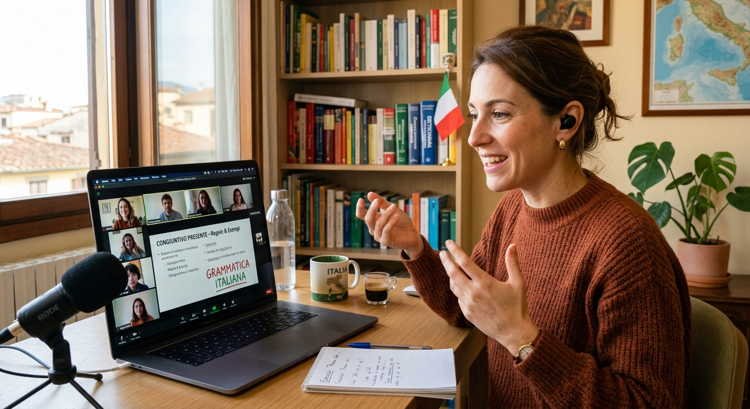
Flexibility is probably the most obvious advantage: you can book a lesson with a teacher living on the other side of the world, without having to travel, saving valuable time — especially if you have a busy schedule. Online lessons also let you choose from a far wider pool of teachers, not limited to whoever happens to live near you.
Another, less discussed advantage: many video-call platforms sometimes let you record the lesson (always ask for teacher’s permission. I don’t allow it for my lessons, for example), share digital materials instantly, and use tools like chat and screen sharing to clear up doubts in real time.
The Advantages of In-Person Lessons
In-person lessons offer a kind of human connection that, for some students, is simply irreplaceable: body language, the ability to share physical materials (books, games, real objects for vocabulary), and generally an atmosphere less “filtered” by a screen.
For those already living in Italy, or in an area with a strong Italian community, in-person lessons also offer the chance to practice the language immediately after the lesson — grabbing groceries or a coffee nearby, for instance.
What to Consider Before Choosing
First, ask yourself how much flexibility you actually need: if your schedule changes often, online lessons offer a practical advantage that’s hard to ignore. Also consider local availability: if there are no qualified Italian teachers in your area, going online massively widens your options.
Finally, think about your focus: some people get distracted more easily in front of a screen, while others find the familiar comfort of home helps them feel more relaxed and less intimidated.

The Hybrid Option: Mixing Both Formats
You don’t necessarily have to pick one format forever. Many of my students mix the two: regular online lessons during busy work weeks, and an in-person lesson whenever they’re visiting Italy or when a local workshop or conversation group is available. This hybrid approach lets you keep the routine going without sacrificing the moments of “real life” practice that only an in-person setting can offer, and it’s worth discussing openly with your teacher rather than assuming it has to be all one or the other.
Practical Requirements Worth Checking in Advance
Before committing fully to online lessons, it’s worth checking a few practical details that are easy to overlook: a stable internet connection, a quiet space where you won’t be interrupted, and basic familiarity with the video-call platform your teacher uses. None of this is complicated, but sorting it out before your first lesson — rather than during it — makes a real difference to how relaxed and focused you’ll feel. The same logic applies to in-person lessons: knowing how long the commute takes, and building it realistically into your schedule, prevents a lesson from starting on the wrong foot because you arrived rushed or late.
A Question Worth Asking Yourself
If you’re still unsure which format to try first, a useful exercise is to picture a typical week and honestly ask where a fixed lesson would realistically fit: at home after work, exhausted, needing the flexibility to reschedule? Or already out and about, close to a school or a teacher’s studio, with time built into your routine? There’s rarely a universally “better” answer — only a format that fits your actual week, rather than the week you wish you had.
Writing the answer down, even in one short sentence, tends to make the decision feel far less abstract than just weighing it in your head.
There’s No “Wrong” Choice
The quality of learning depends far more on the quality of the teacher and the student’s consistency than on the format chosen. Many students who were initially skeptical about online lessons discover, after the first few weeks, that the effectiveness is practically identical — sometimes even better, thanks to the convenience that means never having to skip a lesson for logistical reasons.
If you found this article useful, don’t forget to share it with the world and to like our Facebook Page!
Credits:
Image by Gemini



 Piacere — the Verb That Works “Backwards”