It’s no surprise that a language born in the country of good food has filled its everyday vocabulary with food-related expressions. Italians don’t just talk about eating when they talk about food — they use it to describe emotions, situations, and even someone’s character.
Here are some of the most commonly used expressions — learning them will make you sound far more natural in a real conversation.
Expressions with Pasta and Bread
Essere pane per i denti di qualcuno — to be exactly the right kind of challenge or task for someone (literally, “to be bread for someone’s teeth”). “Questo è pane per I suoi denti!”
Rendere pan per focaccia — to get even, tit for tat, returning a wrong with an equivalent one. “Mi ha fatto un brutto scherzo qualche mese fa, così, appena ho potuto, gli ho reso pan per focaccia”.
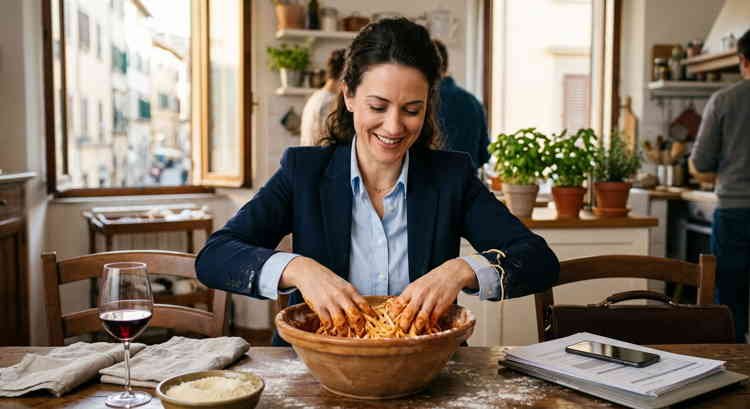
Avere le mani in pasta — to be directly involved in something, often with decision-making power (literally, “to have your hands in the dough”). “Ha avuto le mani in pasta in quella compagnia per anni”

Expressions with Fruit and Vegetables
Non essere farina del proprio sacco — to not be one’s own original idea, to have borrowed or copied something (literally, “not to be flour from one’s own sack”). “Quel discorso non è sicuramente farina del suo sacco.”
Cavolo! — an all-purpose exclamation of surprise or mild frustration, a polite stand-in for a stronger word (literally, “cabbage!”).
Expressions with Wine and Oil
Andare liscio come l’olio — to go smoothly, without a hitch (literally, “to go smooth as oil”). “Il piano è andato liscio come l’olio.”
Essere buono come il pane — to have a kind, generous character, without a hint of malice (literally, “to be as good as bread”). “Suo padre è buono come il pane.”
Why It’s Worth Learning These
Knowing these expressions doesn’t just help you understand movies or conversations between native speakers better — it also helps you sound more natural, less “textbook Italian.” I recommend picking two or three at a time, trying to build a sentence of your own with each, and watching how quickly they become part of your active Italian.
If you found this article useful, don’t forget to share it with the world and to like our Facebook Page!
Credits:
Image by Gemini


 Italian Superstitions — From the Red Horn to Unlucky 17