If you’ve ever ordered “penne all’amatriciana” in front of an Italian and watched their face do something complicated, this article is for you. In Italy, pasta shape and sauce aren’t randomly matched — they follow real culinary logic, refined over generations. Getting it “wrong” won’t ruin your dinner, but understanding why certain combinations exist will genuinely deepen both your Italian vocabulary and your appreciation of the cuisine.
It’s Not Just Tradition — It’s Physics
Italians pair pasta shapes with sauces based on how well the sauce actually clings to (or fills) the pasta. Long, smooth strands behave completely differently from short, ridged tubes, and the “rules” exist because certain textures genuinely work better together.
Long, Thin Pasta → Light, Smooth Sauces
Long strands like spaghetti, linguine, and vermicelli are best with sauces that are thin enough to coat them evenly without clumping — oil-based, seafood, or light tomato sauces.
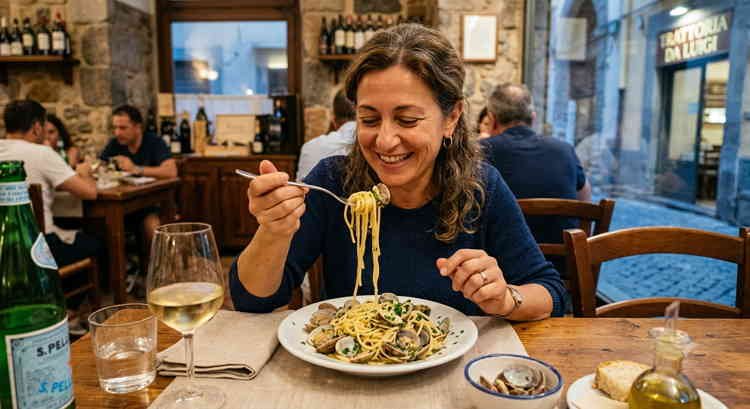
- Spaghetti alle vongole — spaghetti with clams, olive oil, garlic, white wine
- Linguine allo scoglio — linguine with mixed seafood
- Spaghetti aglio, olio e peperoncino — garlic, oil, and chili, the simplest and most iconic combination
A rich, chunky meat ragù, by contrast, tends to just slide off thin strands and pool at the bottom of the plate — which is part of why a “proper” ragù is traditionally paired with something else entirely.
Long, Flat Pasta → Rich, Meaty Sauces
Wider, flatter noodles like tagliatelle and pappardelle have more surface area, which lets thicker, heartier sauces actually cling to them.
- Tagliatelle al ragù — the true home of a slow-cooked Bolognese-style ragù (not spaghetti, despite what’s common outside Italy!)
- Pappardelle al ragù di cinghiale — wide ribbons with wild boar ragù, a classic Tuscan dish

Short, Ridged/Tubular Pasta → Chunky, Hearty Sauces
Shapes like penne, rigatoni, and fusilli are built to trap sauce inside their ridges and hollow centers, making them ideal for thicker, chunkier sauces with vegetables or meat pieces.
- Fusilli al pesto — the spirals hold the pesto beautifully in every bite
- Penne all’arrabbiata — a spicy tomato and garlic sauce that clings well to the ridges
Bucatini: A Shape That Deserves Its Own Sauce
Bucatini all’amatriciana is the classic (and, to many Romans, non-negotiable) pairing — not penne. Bucatini are thick, hollow spaghetti-like strands from Lazio, and their slightly chewy texture and hollow center are a perfect match for amatriciana’s tomato, guanciale (cured pork cheek), and pecorino sauce. The dish is regionally protected in reputation, if not by law, and substituting penne is one of the fastest ways to spot a menu written for tourists rather than by an Italian cook.
Small Pasta → Soups and Broths
Tiny shapes like stelline and ditalini are designed for brothy dishes, where you want small bites in every spoonful rather than a large strand to twirl.
- Pasta e fagioli — pasta and bean soup, often made with ditalini
Orecchiette: Built for Greens
Orecchiette alle cime di rapa is the signature dish of Puglia — the little “ear-shaped” pasta cups the bitter turnip greens, garlic, and anchovy perfectly in its curved shape, something a long strand simply couldn’t do.
The Takeaway (And the Vocabulary to Go With It)
You don’t need to memorize every pairing — but understanding the logic (shape determines how sauce behaves) will help you both order more confidently in Italy and understand why certain “substitutions” you might see abroad make Italians wince a little. It’s also a great, low-pressure way to build food vocabulary: il sugo (the sauce), si abbina bene con (it pairs well with), tiene bene il sugo (it holds the sauce well) are all genuinely useful phrases at the table.
Food is one of the richest, most enjoyable ways to build real Italian vocabulary — and it’s a topic that comes up naturally and often in conversation lessons, where we can talk about your favorite dishes and pick up authentic phrases along the way.
If you found this article useful, don’t forget to share it with the world and to like our Facebook Page!
Credits:
Image by Gemini



 Reflexive Verbs in Italian: The Secret to Sounding Less Robotic